Why Affiliate Marketers Need Landing Pages Instead of Raw Affiliate Links
Affiliate marketers lose clicks, trust, and useful data when they send traffic straight to raw affiliate links. This guide explains how dedicated affiliate landing pages help creators promote products with clearer messaging, better tracking, stronger campaign structure, and more useful performance data.
Tamale Junior Frank
Founder, VeilCode Studio
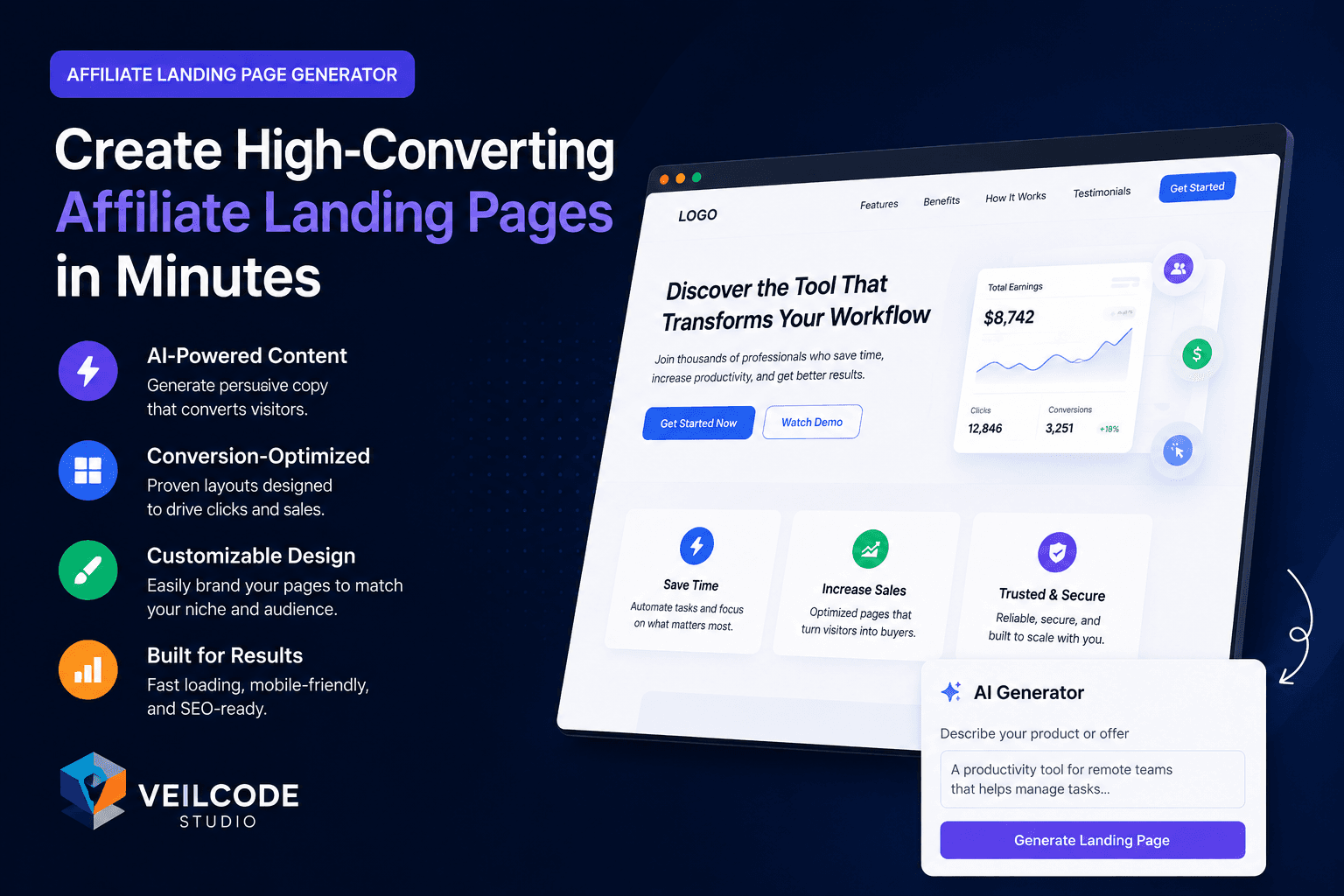
Most affiliate marketers do not fail because they lack links. They fail because they send traffic to links without context, tracking, or a clear reason for the visitor to care.
A raw affiliate link is not a campaign. It is only a destination. If a creator posts a link to Shopify, Hostinger, Semrush, Canva, or any other product without explaining who it is for, what problem it solves, and why someone should click, the promotion depends on luck instead of structure.
Simple rule: do not send serious campaign traffic directly to raw affiliate links. Send it to a focused landing page that explains the offer, tracks clicks, and gives visitors enough context to make a decision.
Raw Affiliate Links Are Weak Promotion Assets
Raw links create three problems. First, they give the visitor almost no context before the click. Second, they make it harder for the affiliate marketer to compare traffic from different channels. Third, they make every campaign look the same inside a basic dashboard.
If someone shares the same affiliate link on TikTok, Instagram, WhatsApp, Facebook, and email, the marketer may see clicks, but without campaign structure they cannot clearly tell which channel created the attention. That means the next decision is based on guesswork.
Raw Link Promotion Problems
The main weaknesses usually appear before the affiliate marketer even checks performance.
Context
Low
Visitors see a link before they understand the offer.
Trust
Weak
There is little explanation, disclosure, or positioning.
Tracking
Limited
Campaign performance is hard to separate by channel.
Optimization
Slow
The marketer does not know what to improve first.
What an Affiliate Landing Page Actually Does
An affiliate landing page gives one product or offer a proper promotion environment. Instead of throwing visitors directly into a merchant website, the page explains the product, frames the problem, shows the use case, adds a clear call to action, and includes an affiliate disclosure.
The page does not need to be complicated. In many cases, a focused page with a strong headline, simple benefits, practical use cases, FAQs, and a tracked CTA is enough to make the campaign more understandable.
- It frames the product: visitors understand what the product is before they leave your page.
- It improves trust: the page can include transparent disclosure and honest positioning.
- It supports campaigns: each page can be shared with campaign URLs for better attribution.
- It creates reusable assets: one landing page can support posts, emails, videos, and community shares.
- It improves learning: clicks can be tracked by product, campaign, source, device, and country.
Affiliate Promotion Asset Comparison
A practical comparison of raw links, public link hubs, and dedicated affiliate landing pages.
View chart data
| asset | Visitor context | Tracking value |
|---|---|---|
| Raw link | 2 | 3 |
| Link hub | 5 | 6 |
| Landing page | 9 | 8 |
Dedicated landing pages usually provide more context before the click and better campaign level tracking after the click. Source: Clickfolio affiliate workflow model
Why Click Tracking and Campaign URLs Matter
Affiliate promotion improves when marketers can separate traffic sources. A click from a WhatsApp status is not the same as a click from a TikTok bio. A click from an email newsletter is not the same as a click from a Facebook group. Campaign URLs help label those sources.
With campaign URLs, one landing page can be shared in different places while keeping the traffic identifiable. The page stays the same, but the campaign data changes.
Example: instead of sharing one clean URL everywhere, create separate campaign URLs for TikTok, WhatsApp, Instagram, email, and Facebook. Then compare which source actually brings clicks.
Example Campaign Source Breakdown
A sample view of how one affiliate landing page might receive traffic from different promotion channels.
View chart data
| source | Clicks |
|---|---|
| TikTok | 45 |
| 25 | |
| 18 | |
| 9 | |
| 7 |
The goal is not just to count clicks. The goal is to know where useful attention is coming from. Source: Example Clickfolio campaign tracking scenario
How Clickfolio Solves the Affiliate Promotion Workflow
Clickfolio is built around a practical affiliate marketing workflow: organize product links, generate dedicated landing pages, share trackable campaign URLs, create promotional content, and review click performance from one dashboard.
The product is not trying to replace affiliate networks. It helps marketers create better promotion assets around the products they already promote.
- 1Add affiliate products: save the product title, description, category, image, destination URL, network, price, and CTA label.
- 2Generate a landing page: use AI to create hero copy, benefits, use cases, FAQs, SEO metadata, disclosure text, and final CTA sections.
- 3Edit with AI: refine weak sections, improve headlines, adjust tone, and make the page more specific before publishing.
- 4Share campaign URLs: create different URLs for TikTok, WhatsApp, email, Instagram, Facebook, or any traffic source.
- 5Track clicks: see which pages, products, campaigns, sources, devices, and countries are getting attention.
Clickfolio Product Loop
The strongest loop is built around publishing and learning, not just collecting links.
Create
Pages
Generate dedicated landing pages for affiliate products.
Share
Campaigns
Use campaign URLs for different channels and audiences.
Track
Clicks
Measure attention by product, page, source, and campaign.
Improve
Copy
Use AI editing and analytics to refine weak pages.
What Every Affiliate Landing Page Should Include
A good affiliate landing page does not need fake hype. It needs clarity. The visitor should understand the offer, who it is for, what problem it helps solve, and what happens when they click.
- Clear headline: explain the product outcome without exaggeration.
- Short subheadline: tell the visitor who the product is for.
- Problem section: describe the pain point the product addresses.
- Solution section: explain the product’s role without inventing claims.
- Benefits: show practical reasons someone may care.
- Use cases: help the visitor see when the product is relevant.
- FAQs: answer common objections before the CTA.
- Affiliate disclosure: make the commercial relationship clear.
- Tracked CTA: route clicks through a tracking endpoint before sending visitors to the merchant.
Expected Improvement Path After Publishing
Affiliate landing pages usually improve after the marketer reviews click data and edits weak sections.
View chart data
| period | Page quality score |
|---|---|
| Draft | 45 |
| First publish | 58 |
| After traffic | 67 |
| After AI edit | 76 |
| After campaign review | 84 |
The first version should be published quickly, then improved using real campaign and click data. Source: Clickfolio page optimization model
Common Mistakes That Hurt Affiliate Campaigns
The worst affiliate pages sound like they were written to trick a click. They make broad promises, hide the affiliate relationship, invent urgency, and fail to explain who the product is actually for.
- Sending traffic to raw links: visitors click without context or leave without understanding the recommendation.
- Using generic AI copy: the page sounds like every other low effort affiliate promotion.
- Hiding the disclosure: the visitor cannot clearly tell that the page contains affiliate links.
- Ignoring campaign sources: the marketer cannot tell whether TikTok, WhatsApp, email, or Instagram is actually working.
- Publishing without editing: generated copy needs review, especially when product details are thin.
- Tracking clicks but not learning from them: data only matters if it changes the next campaign decision.
Final Checklist
- Every promoted product has a clear title, description, category, and destination URL.
- The landing page explains who the product is for.
- The page includes a clear affiliate disclosure.
- The main CTA routes through a tracked Clickfolio link.
- Campaign URLs are used for different platforms and promotions.
- The page avoids fake urgency, unsupported claims, and invented testimonials.
- Analytics are reviewed before creating the next campaign.
- Weak landing page sections are edited instead of blindly regenerated.
The point is not to create more affiliate pages for the sake of volume. The point is to give every serious product promotion a page that explains the offer, tracks the campaign, and gives the marketer enough data to improve. That is where affiliate promotion becomes less random and more operational.
Stay Sharp on What Matters
Engineering deep-dives, design thinking, and practical AI — written for builders who care about craft. No fluff. No spray.
No spam. Unsubscribe any time.