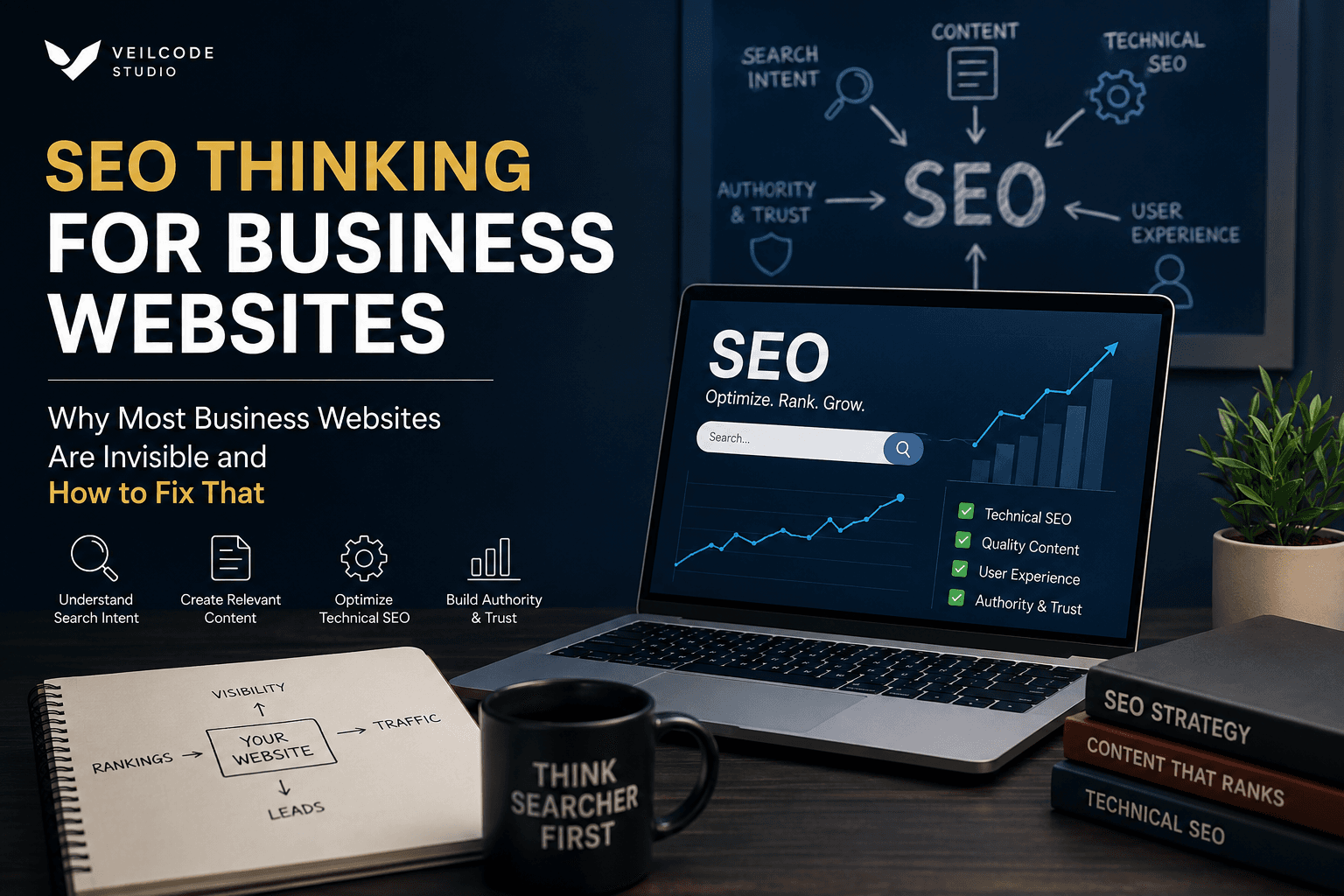
If your business website is not ranking on Google, the first question is not “What SEO trick am I missing?” The better question is whether Google can clearly understand what your business offers, which searches each page answers, whether the page provides useful original information, and whether your site is technically accessible and trustworthy.
A strong business website should make its subject, audience, services, locations, expertise, and important answers clear to both people and search systems. That matters in traditional Google Search and in AI search experiences, where systems retrieve relevant pages to help answer longer and more specific questions.
ℹSimple rule: build pages that answer real customer questions clearly and completely. Then make those answers easy for search engines to crawl, index, understand, and connect to the rest of your site.
Why Is My Business Website Not Ranking on Google?
A business website usually struggles to rank because its pages do not provide a strong enough match for the searches being targeted, the site has technical or indexing problems, the content is too generic, or competing pages have stronger relevance and authority signals. There is rarely one universal ranking failure.
- Unclear search intent: the page targets a phrase without answering what the searcher actually wants to accomplish.
- Generic content: the page describes the business with broad marketing claims without useful specifics, evidence, examples, or original information.
- Weak page targeting: one page tries to rank for several unrelated services or audiences instead of giving important search intents their own useful pages.
- Indexing problems: Google cannot reliably access, crawl, render, or index the content you want it to find.
- Poor page experience: the page is difficult to use, slow, unstable, cluttered, or frustrating on the devices used by visitors.
- Weak internal linking: important pages are isolated, so users and search engines have fewer contextual paths to discover them.
- Limited authority and trust: the site provides little evidence that the business is a credible source for the topic.
What Does Google Need to Understand About Your Website?
Google needs to understand what a page is about, who it is for, what information it provides, and how it relates to other pages and entities on the web. Clear titles, headings, visible text, descriptive URLs, contextual internal links, structured data where appropriate, and accessible page content all help search systems interpret a site.
Structured data does not replace good content. It provides machine readable information about content that should already be represented on the page. Your visible page and your structured data should describe the same underlying information.
The Four Questions Every Important Page Should Answer
Use these questions when reviewing a service page, location page, case study, or article.
Audience
Who?
Make the intended reader or customer obvious from the page.
Intent
Why?
Match the page to what the searcher is trying to accomplish.
Value
What?
Give the visitor useful information they cannot get from generic copy.
Evidence
Why trust?
Support important claims with experience, examples, credentials, outcomes, or other appropriate evidence.
How Should a Business Website Match Search Intent?
Each important page should have a clear primary search intent. A person searching for “how much does a website cost?” needs different information from someone searching for “web development agency in Kampala.” Treating both queries as the same intent makes the page less precise.
- 1Informational intent: the searcher wants to understand a topic, solve a problem, compare approaches, or learn how something works.
- 2Commercial investigation: the searcher is evaluating providers, products, or approaches.
- 3Transactional intent: the searcher is ready to take an action such as requesting a quote, booking a service, or purchasing.
- 4Local intent: the searcher wants a service or business in a specific location.
What Technical SEO Does a Business Website Need?
At minimum, a business website needs to be accessible to Google, indexable, mobile usable, technically stable, and clear about its page structure. Technical SEO creates the conditions for search systems to discover and understand the content. It cannot compensate for content that does not satisfy the searcher.
- Crawlability: do not accidentally block Googlebot from important pages or resources.
- Indexability: make sure pages intended for Search can be indexed.
- Mobile usability: the content and functionality should work well on the devices your audience uses.
- Core Web Vitals: aim for a fast, responsive, and visually stable experience.
- Unique titles and descriptions: give important pages descriptive metadata that accurately represents their content.
- Canonical URLs: where duplicate or near duplicate URLs exist, use canonicalization appropriately.
- XML sitemap: maintain an accurate sitemap that helps search engines discover important URLs.
- Structured data: where supported and appropriate, use valid structured data that accurately represents visible page content.
- HTTPS: serve the site securely and consistently over HTTPS.
⚠Do not confuse technical scores with rankings. Passing Core Web Vitals or another technical audit does not guarantee a top position. Search systems still have to determine that the page is relevant and useful for the query.
What Kind of Content Helps a Business Website Rank?
Useful business website content answers a specific customer need with information that is accurate, relevant, sufficiently complete, and genuinely useful. It should demonstrate what the business knows and, where appropriate, what the business has actually done.
- Use real specifics: explain processes, constraints, examples, technologies, locations, prices where appropriate, timelines, outcomes, or decision criteria.
- Answer the primary question early: give the reader a direct answer before expanding into background and nuance.
- Cover useful follow up questions: anticipate the next decisions a reader is likely to make without padding the article with unrelated material.
- Show experience: use case studies, implementation details, original observations, screenshots, examples, or other evidence when relevant.
- Keep information current: review pages when important facts, products, technologies, pricing, or business offerings change.
- Write for the customer: publish to help the intended audience, not to manufacture pages solely for search traffic.
There is no useful universal word count for SEO. A page should be as long as necessary to satisfy its purpose without adding repetitive material.
How Do Internal Links and Authority Help SEO?
Internal links help users and search engines discover related pages and understand how your content fits together. Important pages should not exist as isolated URLs. Link to them from relevant pages using concise, descriptive anchor text.
External authority is a separate problem. Links and mentions from other credible sources can provide useful signals about reputation and relevance. The objective should be to earn legitimate references through useful work, original research, partnerships, digital PR, community participation, and genuinely valuable resources.
How Does SEO Relate to AI Search and Website Recommendations?
AI search does not require a separate secret version of SEO. The same fundamentals that help content perform in normal Search also matter in AI search experiences. Pages need to be accessible, indexable, useful, original, and easy for search systems to understand.
AI search systems can retrieve relevant web pages and use information from those pages when constructing answers. This makes clear, self contained answers valuable. A page that directly answers a real question gives a retrieval system a stronger piece of information to understand than a page filled with vague marketing language.
Make Important Information Easy to Retrieve
Structure important pages so individual answers remain understandable when encountered outside the context of the entire article.
Question
Explicit
Use clear headings that identify the problem or question being answered.
Answer
Direct
Give the main answer near the beginning of the relevant section.
Evidence
Specific
Support important claims with experience, examples, sources, or observable facts.
Context
Connected
Use internal links and surrounding sections to establish topical relationships.
ℹImportant: there is no guaranteed method that makes an AI system recommend your website. The controllable objective is to publish useful, original information, make it accessible to search systems, establish topical and business context, and measure visibility and conversions over time.
What SEO Mistakes Should Business Owners Avoid?
- 1Writing for keywords instead of customers: a page stuffed with phrases can still fail to answer the underlying question.
- 2Making every page sound the same: each important page should have a distinct purpose.
- 3Creating thin location pages: changing the city name on a template does not create useful local content.
- 4Publishing generic AI generated articles at scale: automation does not create value by itself.
- 5Ignoring internal links: strong articles and service pages should be connected through relevant contextual links.
- 6Hiding important content: the information users and search engines need should be accessible on the page.
- 7Overstating ranking factors: avoid presenting speculative SEO scores or secret weights as published Google rules.
- 8Measuring rankings alone: track impressions, clicks, qualified organic traffic, leads, sales, and other business outcomes.
What Should You Do First to Improve Your Website's SEO?
- 1Check indexing first: confirm that important URLs can be crawled and indexed.
- 2Define your priority customers: identify who you want to attract and which searches indicate meaningful intent.
- 3Map search intent to pages: decide which page should answer each important query.
- 4Improve the highest value pages: start with core service pages, location pages, case studies, and high intent content.
- 5Strengthen the technical foundation: fix crawlability, indexability, broken links, metadata, canonicalization, performance, mobile usability, and structured data.
- 6Build internal links: connect related articles, services, case studies, and important commercial pages.
- 7Add evidence and original value: show real experience, examples, outcomes, methodologies, and useful information.
- 8Measure the result: monitor Search Console visibility and traffic alongside leads and other business outcomes.
- 9Update based on evidence: improve pages that receive impressions but underperform and expand topics where users show demand.
SEO is an iterative process. Technical fixes can improve accessibility quickly, while content relevance, authority, and competitive positioning can take longer to develop. The objective is to make every important page more useful and easier to understand, then use actual search and business data to decide what to improve next.
Common Questions About Business Website SEO
How Long Does SEO Take to Work?
There is no fixed SEO timeline. Technical corrections can become visible after Google recrawls and reprocesses affected pages, while competitive queries can require substantially more time because content quality, authority, and competition all matter.
Does Website Speed Affect Google Rankings?
Page experience matters to Google Search, and Google recommends achieving good Core Web Vitals. Good performance does not guarantee a high ranking because relevance and content quality remain fundamental.
Can AI Generated Content Rank on Google?
AI assisted or AI generated content can appear in Google Search when it meets Google's quality requirements. Google does not give content a ranking advantage simply because AI was used. The risk comes from producing large amounts of low value or unoriginal content primarily to manipulate rankings.
Does Structured Data Make a Website Rank Higher?
Structured data helps search engines understand eligible content and can make pages eligible for certain search features. It is not a general ranking shortcut and Google does not guarantee that structured data will produce a rich result.
Can I Make Google or an AI System Recommend My Website?
There is no guaranteed method. The practical strategy is to create useful original content, make the site accessible and understandable, establish credible business and topical context, connect related pages, and satisfy the needs behind relevant searches.
The best business website for SEO is not the one with the most keywords or the longest articles. It is the site that makes its expertise clear, answers real customer questions, provides evidence and useful detail, maintains a strong technical foundation, and gives search systems enough context to understand what each page is useful for.